
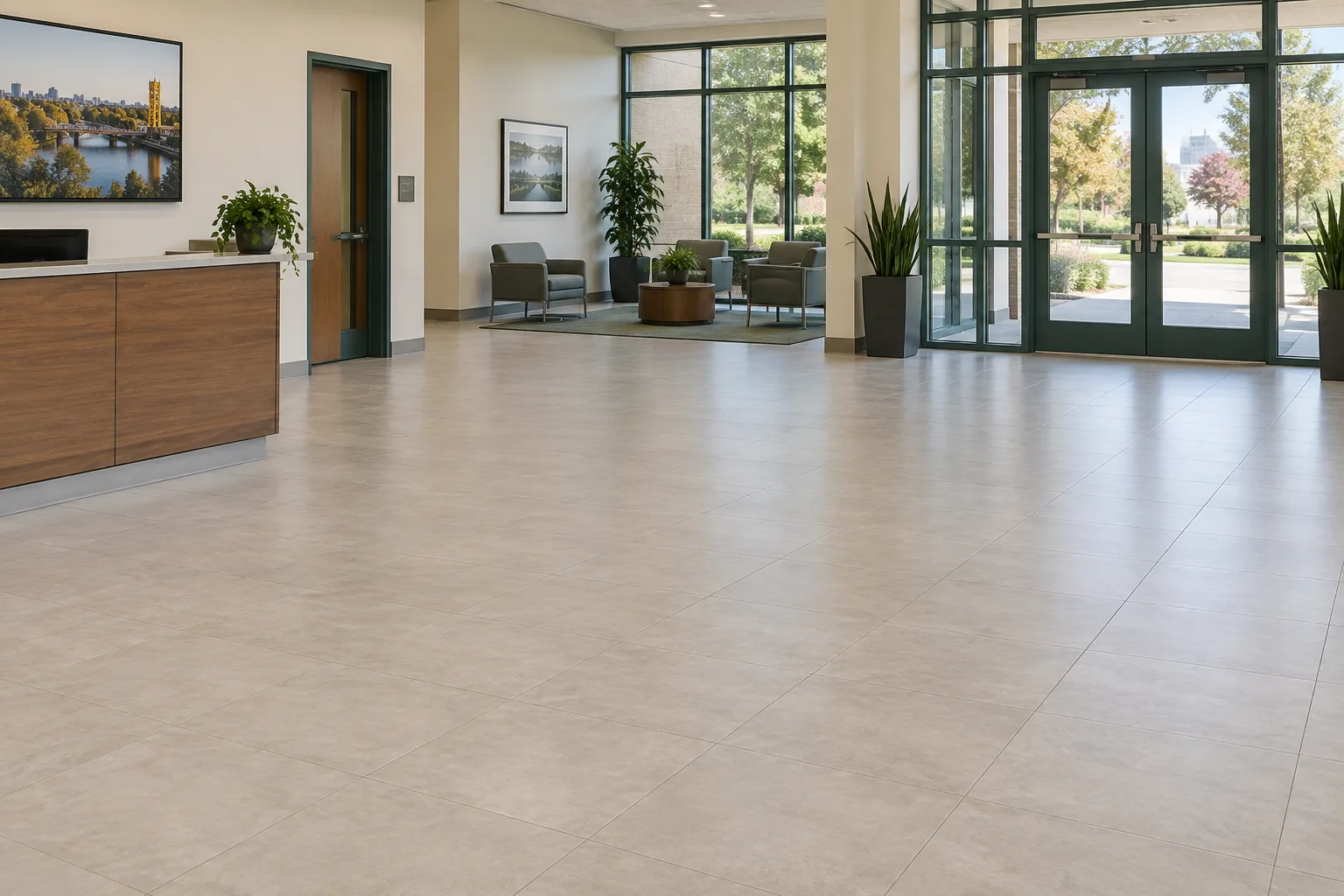
Commercial floor care in Sacramento
Keep commercial floors clean and their finish looking sharp through regular and periodic care.
Scrubbing for soil and buildup
Hard floor scrubbing lifts soil from tile, bare or coated concrete and vinyl in entrances, corridors and commercial work areas. We match concrete floor scrubbing to the slab and coating condition, and we plan drainage and machine access before the visit.
Care for the existing finish
Recoating lays a fresh maintenance coat over a clean, prepared finish, and burnishing brings back the shine on VCT and other resilient floors between deeper treatments.
Stripping and waxing resilient floors
We strip and wax vinyl composition tile (VCT) and other resilient floors, removing worn finish and laying down fresh coats.
Marble and terrazzo cleaning and polishing
Marble, terrazzo, granite and other natural stone at entries and lobbies are cleaned with stone-safe products, then polished to bring back their depth and shine. Regular cleaning and periodic floor maintenance can be coordinated with the broader janitorial service for your building.
Planning periodic floor work
Entrances and main corridors usually show wear before the rest of a building. Scheduling scrubbing, recoating or burnishing for those areas first keeps the floors visitors see looking cared for, while lighter-use rooms are treated as their condition calls for it.
Floor work fits with your recurring janitorial service, which keeps up routine floor cleaning between treatments. Industrial properties can add concrete scrubbing alongside industrial cleaning, and government buildings can refresh busy corridors as part of government building cleaning.
Hard floors in Sacramento buildings
Floor types vary widely across Sacramento’s commercial buildings. Government and administrative offices often run resilient tile through their corridors, warehouses and distribution space sit on bare or coated concrete, and retail entries and lobbies use tile or natural stone to make an impression. Each surface has its own periodic treatment, so a single property can call for more than one service.
The work is matched to the material: stripping and waxing for vinyl composition tile, burnishing to bring back the shine of a sound finish, recoating when the finish is thin but intact, scrubbing for soil on concrete and tile, and cleaning and polishing for marble, terrazzo, granite and other natural stone.
Scheduling floor work around your business
Most floor treatments need the area clear while the work is done and while the finish dries or cures. For an office that means an evening or weekend; for a retail store, the hours after closing; for a warehouse, a gap when loading activity pauses. Large floors can be treated in sections so part of the building stays in use.
Between treatments, the recurring routine keeps the surface clean with sweeping and mopping, which protects the finish and stretches the time before the next strip or recoat. Buildings with carpeted offices can book commercial carpet cleaning in the same quiet window.
Choosing a treatment interval
Traffic sets the pace. An entrance that takes grit from the parking lot every day shows wear well before a back corridor, so burnishing or recoating at the door comes around more often than a full strip. Full strip and wax cycles are kept for floors where the finish has worn through or built up unevenly.
Entrance mats belong in the same plan. Clean entrance mats catch soil before it reaches the floor, keeping the polished area by the door looking better for longer.
How Sacramento floor care is priced
Periodic hard-floor work in Sacramento runs by the square foot, and small jobs carry a minimum charge. In 2026 market rates, stripping old finish and laying new coats on vinyl tile typically costs $0.45 to $1.00 per square foot, a scrub and recoat starts near $0.35, and neglected or heavily built-up floors run to $3.00.
A 2,800-square-foot clinic hallway and waiting room with thick, yellowed finish, stripped and refinished at $0.85 a foot, costs $2,380. The same space on a quarterly scrub and recoat afterward costs under half that per visit, which is why a treatment interval beats waiting for a full strip.
Finish buildup and floor condition matter most. Several old coats, black heel marks and worn traffic paths take longer to remove than a single layer, and natural stone needs its own products and polishing steps. Furniture, display fixtures and mats that have to be moved add time, as do edges and corners done by hand. The floor has to stay closed while it dries, so most work happens after hours or on weekends. Regular burnishing stretches the time between strips. Show us the floors on the walkthrough, and we’ll quote the treatment and interval that fit. Floor work is priced next to carpet and nightly service in our Sacramento pricing guide.
A few useful answers
Commercial Floor Care Questions
Can you clean our entrance mats?
Yes. We clean customer-owned entrance mats and let them dry fully before they go back down.
What information helps you quote floor care?
Send the floor material, approximate area and main concern. Include the finish or coating if known; photos can help show the surfaces involved.
Which floors can be stripped and waxed?
Vinyl composition tile (VCT) and other resilient floors. Tell us the floor type and we can recommend the right process.
Can floor care be scheduled when the building is closed?
Yes. Treatments can be arranged for a time when the area can stay clear, so drying and curing can finish before the area reopens.
Is concrete scrubbing available for warehouse slabs?
Yes. We scrub bare and coated concrete slabs, with drainage and equipment access planned before the visit.
How is burnishing different from stripping and waxing?
Burnishing polishes a sound existing finish to restore its shine. Stripping removes the old finish entirely so fresh wax can go down on VCT or other resilient flooring.
Can floor care be combined with our regular janitorial visits?
Yes. Periodic treatments are booked as separate visits, and the regular janitorial routine keeps the floor clean in between.
Services
Related services
Resources
Related guides
Industries